How AI Personalization Is Reshaping the Ecommerce Website Experience in 2026
Updated: Jul 14
Table of Contents

The Shift from Segment to Individual
From Segments to Individuals
For most of ecommerce's history, personalization meant showing different experiences to different customer segments.
For example, a retailer might show one promotion to first-time visitors and another to returning customers. Useful, but still broad.
Today, AI enables personalization at the individual level.
Two returning customers can see completely different product recommendations, content and offers based on their browsing behaviour, purchase history and real-time interactions. One may be shown running shoes, while another sees gym apparel.

Why This Shift Matters
Customer expectations have changed alongside the technology.
McKinsey found that 71% of consumers expect personalised interactions, while 76% become frustrated when they do not receive them.
The challenge for ecommerce businesses is that shoppers now compare every online experience to the platforms they use most often. Amazon, Shopee and TikTok Shop have trained customers to expect relevant recommendations and tailored content.
When an ecommerce website delivers the same experience to every visitor, it can feel less relevant and less engaging by comparison.
Where AI Personalization Creates Value
Product Recommendations
Product recommendations remain one of the most effective applications of AI in ecommerce.
A 2025 study found that personalised recommendations can generate significantly higher conversion rates than generic product displays, while also increasing average order value across multiple ecommerce categories.
The reason is simple: shoppers are shown products that are more relevant to their interests and purchase intent, rather than the same products being promoted to everyone.

AI can use signals such as:
Browsing behaviour
Purchase history
Products viewed during the current session
Real-time shopping intent
However, relevance alone is not enough.
One often-overlooked factor is placement. Recommendations shown in the cart or immediately after a shopper adds an item to their cart often perform well because purchase intent is already established at that stage.
The strongest recommendation programmes focus on both relevance and timing.
ICTS Digital Transformation helps businesses design ecommerce experiences that surface the right products at the right stage of the customer journey.
Search Personalisation
Search plays a major role in product discovery, particularly on mobile. AI has made ecommerce search significantly more effective by understanding shopper intent, instead of simply matching keywords.
This means customers are more likely to find relevant products quickly, even when their search terms are vague, conversational or incomplete.

The business impact can be substantial. According to Algolia's 2024 Ecommerce Site Search Trends report, shoppers who use site search typically convert at 2–3 times the rate of those who browse. As a result, improving search relevance has become one of the highest-impact ways to increase ecommerce conversions.
To learn more about how changing mobile shopping behaviour is reshaping ecommerce experiences, read Mobile Commerce Is Now the Majority — What That Means for Your Ecommerce Website Design.
Post-Purchase and Retention Personalisation
The value of AI personalisation does not end at the first purchase. In many cases, the greatest returns come from encouraging customers to buy again.
A 2025 peer-reviewed study found that AI-driven personalisation can significantly improve customer satisfaction and repeat purchase intent. The research also showed that higher customer satisfaction increases the likelihood of future purchases.
This is why many ecommerce brands are investing in personalised post-purchase experiences. By using customer behaviour and purchase history to deliver more relevant recommendations, offers and communications, businesses can strengthen retention and increase customer lifetime value over time.

Unlike one-time conversion optimisation, these gains compound with every repeat purchase.
To learn more about the broader strategies behind building a high-converting ecommerce store, read How to Build an Ecommerce Website That Actually Drives Sales in 2026.
Dynamic Pricing
Dynamic pricing is where AI personalisation moves from improving customer experience to directly influencing revenue. It is also one of the most controversial applications.
Rather than showing the same price to every visitor, AI can adjust prices based on factors such as demand, inventory levels, competitor activity and customer behaviour.
This allows businesses to respond more quickly to market conditions and improve pricing effectiveness.

A 2024 study found that AI-driven pricing can improve pricing performance in competitive markets, although customer price sensitivity remains an important constraint.
The challenge is balancing revenue optimisation with customer trust. Research from Harvard Business School suggests that pricing algorithms can contribute to higher prices over time as systems continuously respond to market signals and competitor pricing. For ecommerce businesses, the question is not simply whether dynamic pricing increases revenue, but how to use it without creating a perception of unfairness.
The practical considerations are different from those facing large platforms:
Approach | Where it works | Where it backfires |
Demand-based pricing | Clearance, limited stock, seasonal peaks | Loyal customers buying a frequently repurchased item notice |
Competitor-responsive pricing | Commoditised categories where price is the differentiator | Premium brands where price signals quality |
Personalised pricing | Promotional offers based on individual purchase history | Visible price differences between users damage trust |
The biggest challenge with dynamic pricing is not technology. It is customer trust.
If shoppers feel they are being charged unfairly, the resulting loss of trust can outweigh any short-term revenue gains. For many SMEs, protecting customer confidence is often more valuable than maximising pricing efficiency.
AI Is Changing How Customers Discover Products
AI Is Becoming a New Discovery Channel
The way shoppers discover products is starting to change.
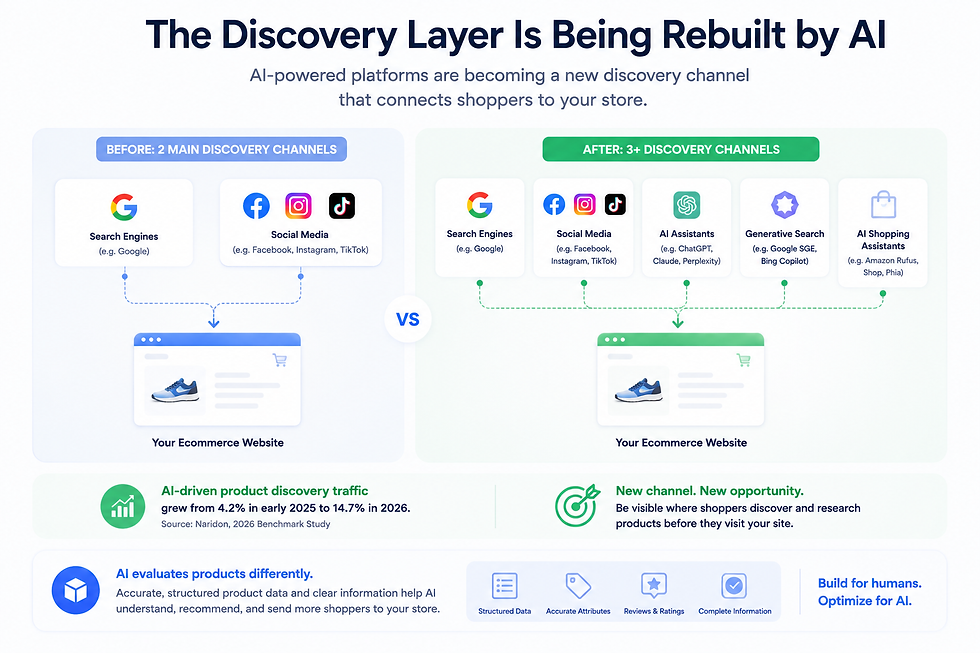
For years, ecommerce businesses focused on two main channels: social media and traditional search. Today, AI shopping assistants and generative search engines are becoming a third discovery channel, helping consumers research products before they ever visit a website.
The shift is happening faster than many businesses realise. A 2026 benchmark study by Naridon found that AI-driven product discovery traffic increased from 4.2% of ecommerce discovery traffic in early 2025 to 14.7% just one year later.
AI Evaluates Products Differently
What makes this channel different is how products are selected.
AI systems depend on structured product information, specifications, reviews and other machine-readable data to determine which products to recommend.
What This Means Practically
Ecommerce websites are no longer being built solely for human visitors. They are increasingly being built for both shoppers and AI systems.
Businesses that invest in accurate product data, clear product information and well-structured content are more likely to appear in AI-generated recommendations. Those that do not may find themselves missing from an emerging discovery channel, regardless of how well they perform in traditional search.
This is where ecommerce website design, technical SEO and GEO (Generative Engine Optimisation) are beginning to converge.
To learn more about how GEO change the way a website is created, read How AI Search Is Changing What a Website Development Company Needs to Build in 2026
ICTS Digital Transformation helps businesses structure ecommerce content and product data to support both search visibility and emerging AI discovery channels.
Building the Right Data Foundation
First-Party Data
Effective personalisation depends less on algorithms than most businesses assume.
The real advantage comes from having access to high-quality customer data.
As third-party tracking becomes less reliable, ecommerce brands are increasingly relying on first-party data - information gathered directly through customer interactions with their own store.
Examples include:
Purchase history and browsing behaviour
Search activity and product interests
Email engagement and loyalty programme interactions
Preferences shared through quizzes, account settings or onboarding flows
Some of the most valuable data is what customers choose to share voluntarily.
Preference quizzes, product finders and onboarding flows often provide stronger signals than inferred behaviour because they reflect explicit customer intent.

Technical Implications
Personalisation is only as effective as the data available to support it.
Decisions such as:
Platform selection
CRM and marketing integrations
Event and conversion tracking
Customer account and preference capture flows are not simply technical considerations. They determine what customer insights can be collected and how effective future personalisation efforts will be.
To learn more about how customer data is collected, organised and used across the customer journey, read What is a CRM System? A Guide for Small Businesses.
The businesses that benefit most from AI personalisation are rarely the ones with the most advanced tools. They are often the ones that have built a stronger data foundation from the start.
ICTS Digital Transformation helps businesses plan the data, integrations and customer journeys needed to support long-term personalisation efforts.
Building Personalization Responsibly
The Tension Between Personalisation and Privacy
Here is the challenge many ecommerce businesses face: customers expect personalised experiences, yet they are increasingly uncomfortable with how their data is collected and used.
This tension is often referred to as the personalization-privacy paradox. Consumers appreciate relevant recommendations, tailored offers and personalised shopping experiences, but they become less receptive when personalisation feels intrusive or overly reliant on tracking.
Recent research has shown that personalisation can improve the customer experience by reducing effort and helping shoppers find relevant products more quickly. However, the same research found that privacy concerns can undermine these benefits when customers do not trust the brand handling their data.

Making the Value Exchange Obvious
The difference is transparency.
When customers understand what data is being collected and receive a clear benefit in return, personalisation tends to strengthen trust. When tracking happens without a clear value exchange, the opposite can occur.
The most effective brands do not simply personalise more. They make the value exchange obvious. "We remember your preferences to save you time" is far more persuasive than silently collecting data and expecting customers to be comfortable with it.
Where Singapore Businesses Stand
Singapore Shoppers Already Expect Personalisation
Consumers in Singapore are already accustomed to highly personalised shopping experiences on platforms such as Shopee, Lazada and TikTok Shop.
Product recommendations, personalised feeds and tailored promotions have become part of the normal ecommerce experience.
As a result, shoppers increasingly expect online stores to surface relevant products, content and offers.
Many Brand-Owned Stores Are Still Catching Up

While consumer expectations have evolved quickly, many brand-owned online stores are still in the early stages of AI adoption and personalisation.
This creates a valuable opportunity. Shoppers who regularly browse highly personalised marketplaces will notice the difference when an ecommerce store shows the same products, messages and promotions to every visitor.
The good news is that standing out does not require a sophisticated AI strategy from day one. In many cases, relatively simple improvements can already create a noticeably better customer experience:
Product recommendations based on browsing or purchase history
Personalised email flows triggered by customer behaviour
Dynamic content that highlights relevant products or categories
Preference-based customer accounts that improve future interactions
For many ecommerce businesses, the goal is not to match the capabilities of major marketplaces overnight. It is to make each customer interaction feel more relevant than it did before.
What This Means for Ecommerce Website Design
AI personalisation is not something you bolt onto an ecommerce website after launch. To work effectively, it needs to be considered during planning and development from the start.
Decisions made during the build that determine personalisation capability

Design decision | Personalisation impact |
Platform selection | Does it support native recommendation engines and API integrations for external AI tools? |
Customer account architecture | Is the onboarding flow designed to capture preferences? Does login history feed into personalisation logic? |
Event tracking setup | Are browse events, search queries, product views, and add-to-cart actions firing consistently? |
Product data structure | Are attributes, specifications, and metadata complete enough for recommendation engines to use? |
CRM integration | Is customer purchase data syncing with the ecommerce platform in real time? |
Email and SMS flows | Are post-purchase and abandon sequences set up to use individual-level signals, not just segment rules? |
For businesses planning a new ecommerce website or redesign, personalisation should be considered from the start rather than added later.
That means thinking beyond design, product pages and checkout flows. The website also needs a way to collect useful customer insights and turn them into more relevant shopping experiences over time.
A high-performing ecommerce website in 2026 is not just designed to sell. It is designed to learn what customers are interested in and use those insights to improve future interactions.
To learn more about the ecommerce features that support customer engagement and conversion growth, read 67 Must-have Features of an Online Store Website.
Planning a new ecommerce website or redesign?
ICTS Digital Transformation helps your businesses choose the right platform, integrations and customer experience strategy from the start. This creates a stronger foundation for personalisation and long-term growth.
Key Takeaways
AI personalisation is now the baseline, not a differentiator: Shoppers trained by Amazon, Shopee and TikTok Shop expect relevance by default. Stores that show the same experience to every visitor risk feeling generic.
The highest returns concentrate in three areas: Product recommendations, on-site search and post-purchase retention consistently outperform other personalisation applications.
AI is becoming a third discovery channel: AI shopping assistants and generative search are changing how consumers find products before they visit a store. Structured, accurate product data determines whether a business appears in these recommendations.
Dynamic pricing works but trust is the real risk: The challenge is not technical. Shoppers who feel they are being charged unfairly will disengage, and that loss often outweighs any short-term revenue gain.
Transparency is what resolves the privacy paradox: Customers are more comfortable with personalisation when they understand what data is collected and what they get in return. Making the value exchange explicit builds trust rather than eroding it.
First-party data matters more than the tools: The businesses that benefit most are rarely those with the most advanced AI. They are the ones that built a stronger data foundation from the start.
Personalisation has to be built in, not bolted on: Platform selection, event tracking, CRM integration and account architecture all shape what personalisation is possible. These decisions need to be made during the build, not after launch.


